Peanuts' Pay, 5 Years on the Job, No Promotion: Oracle Employee Wonders If He's Layoff-Proof
Oracle shed 21,000 roles in the year to May, and managers have been asked for new names before September

An Oracle employee approaching five years in the same role, never promoted and, by their own account, poorly paid for it, has put a blunt question to colleagues online. Does being cheap protect a worker from redundancy or invite it? The question arrived days after Oracle drew up plans for another round of cuts.
Thousands of colleagues are asking a version of the same thing. Oracle removed about 21,000 roles in the financial year to 31 May, a fall of roughly 13%. An internal document reported on 11 August has managers naming more before the second quarter opens on 1 September.
Where the Money Went
These cuts are not a response to weak demand. They are the cost of an artificial intelligence (AI) building programme. Oracle spent $55.7B on capital projects in the last financial year against $21.2B the year before, as the chart below shows.
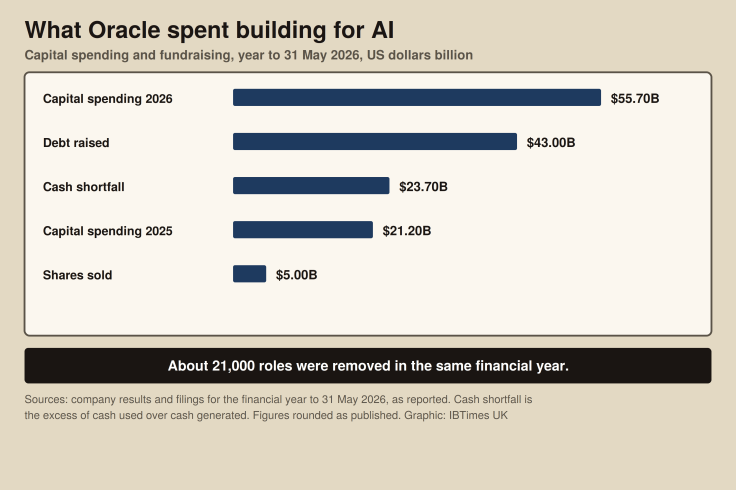
Paying for that meant borrowing. The company raised $43B in debt and another $5B by selling shares, and expects to raise roughly $40B more over the coming year. Interest on that scale of borrowing falls due to whatever the demand picture looks like.
Payroll is the fastest lever available to a company in that position. That explains the timing, and it explains why the cuts are landing at a business reporting rising demand rather than falling.
Whether Being Cheap Is Protection
The blunt answer is that saving one salary is rarely the point. The reported cuts are being applied team by team, with some units facing double-digit percentage reductions. The unit is chosen before the individual, and an inexpensive employee on a targeted team is still on a targeted team.
Steady performance carries a similar catch. Where a rating scale reserves its top band for people already flagged for promotion, a career of solid marks produces a record that looks identical to everyone else's. That is a thin defence when a manager is asked to rank a team and submit names.
What a British Worker Gets That an American One Does Not
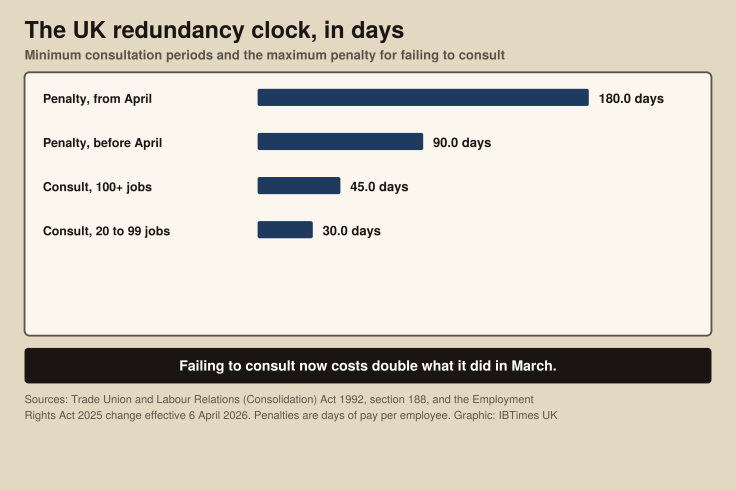
The employee who asked the question is based in the United States, where employment is generally at will, and a company may end a job without giving a reason. British law works differently, and the gap widened this year, as the graphic below shows.
Where an employer proposes 20 or more redundancies at one establishment within 90 days, collective consultation becomes compulsory under section 188 of the Trade Union and Labour Relations (Consolidation) Act 1992. The duty is statutory rather than contractual, and no wording in an employment agreement removes it.
Where 20 to 99 jobs are affected, the process must open at least 30 days before the first dismissal. Where 100 or more go, the minimum is 45. Getting it wrong now costs up to 180 days' pay for every affected employee, double the ceiling that applied before 6 April.
Consultation is meant to be genuine rather than presentational. Its statutory purpose is to reach agreement on avoiding the dismissals, reducing their number or softening their effect, which is why running the process with the outcome already settled attracts the heaviest awards. Staff or their representatives can challenge the pool, question the scoring, and ask what redeployment was actually explored.
Selection has to be defensible too. Tribunals apply what is known as the range of reasonable responses test, asking in effect whether a sensible employer could have done the same thing. They look at how the pool was drawn and how consistently the criteria were used. A pool narrowed to fit an answer already chosen is among the most common reasons these claims succeed.
None of that reaches the person who posted the question. It does reach the British colleague working on the same product, which is the part worth knowing before an email arrives rather than after. One limit still applies. Unfair dismissal claims require two years on the payroll, and that requirement stays in place until 2027, so the newest hires remain the least covered.
© Copyright IBTimes 2025. All rights reserved.
- Recommended For You