

Professor Brian Cox Reveals Why Finding Aliens Would Be a 'Weight off Our Shoulders' Eventually
Cox says finding intelligent aliens could ease a terrifying fear about humanity's place in the universe

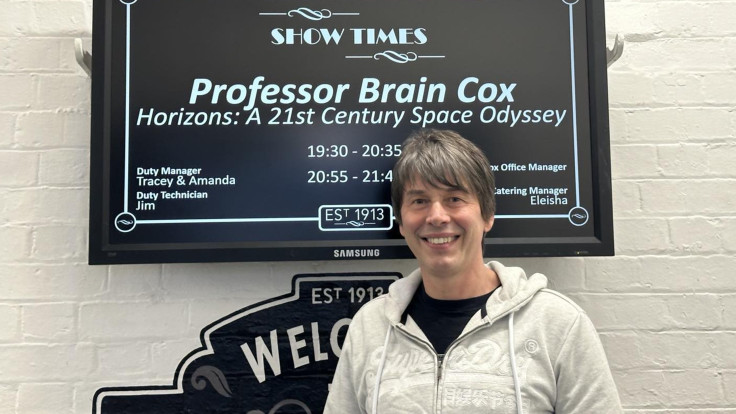
Professor Brian Cox says finding intelligent aliens would ease a fear he finds 'terrifying,' that humanity might be alone in preserving meaning in the universe.
The British physicist discussed the possibility in a LADbible interview published on Sunday, 18 October 2026. He said the existence of another civilisation would take a 'weight off our shoulders.'
Cox was reflecting on the search for extraterrestrial intelligence, which has not yielded a confirmed alien signal. He suspects microscopic life could be widespread but believes advanced civilisations may be exceptionally rare. Neither idea is supported by scientific evidence.
His concern is less about alien spacecraft arriving on Earth than what could happen if humanity vanished. Would there be another civilisation capable of thought and experience elsewhere?
Why Brian Cox Thinks Intelligent Alien Life Could Be Rare
Cox pointed to SETI, the Search for Extraterrestrial Intelligence, which has spent decades looking for signs of technological societies.
According to the SETI Institute, no search has produced a confirmed extraterrestrial signal, although researchers have investigated intriguing candidates. None has met the standard needed to establish a discovery.
Cox called the lack of confirmed detections the 'great silence.' Given the enormous number of worlds and the time available for civilisations to develop, he considers it a mystery. He suggested that other societies might have evolved far beyond humanity, yet remained undetected.
But an unanswered search cannot settle whether Earth has company. The SETI Institute says failure to find a signal does not prove that humans are the only intelligent beings in the galaxy. Cox has also questioned whether searches focused on technology familiar to humans might overlook other forms of communication.
Cox also distinguished simple organisms from intelligent life. He speculated that microbes might exist elsewhere in the solar system, naming Mars and Europa, a moon of Jupiter. No confirmed evidence of life exists on either world.
NASA continues to investigate whether Mars once offered conditions suitable for life. Europa interests scientists because evidence points to an ocean beneath its icy surface. Neither line of research has found living organisms.
The leap from a single cell to intelligence is another matter. Cox suspects it could take an extraordinarily long time, which may explain why technological civilisations might be rare. That remains his hypothesis, not a demonstrated explanation for the silence.
Brian Cox Says Alien Neighbours Would Ease a 'Terrifying' Responsibility
What Cox would find reassuring is the discovery of another intelligent civilisation, particularly one close enough to visit. He said he would 'absolutely love that' because it would take a 'weight off our shoulders.' He was expressing a hope, not claiming that alien visitors exist.
His reasoning is philosophical. If intelligence is exceptionally rare, he believes humans might carry an unusual responsibility to ensure that meaning survives in their region of space. He described that prospect as 'terrifying.'
Cox raised the possibility that 'some idiot presses the wrong button,' an allusion to humanity's capacity for self-destruction. If another intelligent society existed, he suggested, meaning might endure elsewhere even if humans were no longer around.
He also invoked a familiar cosmological principle: humanity does not occupy a special place in the universe. Yet that principle doesn't answer how often intelligence develops. A vast universe may hold countless habitable places, but it doesn't tell scientists how many are inhabited.
The interview also turned to Area 51, the secretive Nevada facility often associated with alien conspiracy theories. The CIA says the site was used to test reconnaissance aircraft, including the U-2, and rejects stories about stored flying saucers.
Cox acknowledged that governments can keep secrets, including information about nuclear weapons technology. He doubted they could conceal an enormous base filled with extraterrestrial spacecraft. 'I don't think there's anything there at all,' he said.
© Copyright IBTimes 2026. All rights reserved.