Astronomers Detect the First Direct Radio Signal From an Exoplanet but Disappoint Alien Enthusiasts
MeerKAT observations suggest the young planet has a magnetic field thousands of times stronger than Earth's, but the findings are not yet peer reviewed
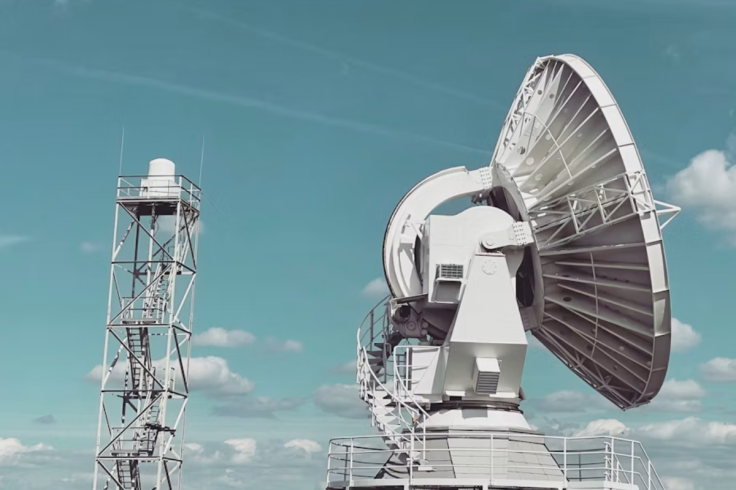
Astronomers have detected radio emission directly traced to an exoplanet for the first time, identifying Beta Pictoris b as the source during observations made in 2025 and 2026 with the MeerKAT radio telescope array in South Africa.
The finding, announced by researchers from the Center for Astrophysics | Harvard & Smithsonian and the University of Oregon, provides what the researchers describe as the first direct measurement of magnetic-field strength for an exoplanet. The research has not yet been published in a peer-reviewed journal and is available online through arXiv.
Exoplanet Radio Signals Traced to Beta Pictoris b
Radio detections from planet-hosting systems have previously been difficult to attribute directly to an exoplanet rather than its host star. In this case, the researchers say they were able to localise the emission to Beta Pictoris b with a high degree of certainty.
The observations focused on Beta Pictoris, a star located about 64 light-years away that has three known planets, Beta Pictoris b, c and d. The MeerKAT array recorded the system on four separate occasions during 2025 and 2026, detecting rapid, recurring and strongly circularly polarised radio bursts alongside persistent emission at frequencies between 0.8 and 3.5 GHz.
The researchers used quasars as reference points when mapping the radio signals. This allowed them to distinguish the source from Beta Pictoris itself and identify planet b as the origin of the detected emission.
The radio bursts are linked to auroras rather than evidence of extraterrestrial communication. According to the researchers, the emission is produced through electron cyclotron maser instability (ECMI), a process associated with auroral radio emission in planets including Earth and Jupiter.
Auroras Help Explain the Exoplanet Radio Signals
Beta Pictoris is classified as an A6V star, meaning it is hotter and more massive than the Sun. The researchers state that known mechanisms responsible for radio emission from the star cannot readily explain the observed signal.
Instead, the characteristics of the emission point to ECMI. The process produces coherent, highly polarised radio emission and is associated with auroral activity in planetary magnetospheres.
The researchers say ECMI provides information about a planet's magnetic field because the frequency of the emission is linked to the magnetic-field strength at its source. A burst detected up to 3.5 GHz implies a magnetic field of at least 1.25 kilogauss at the emission site.
The researchers describe the result as the first direct measurement of magnetic-field strength for an exoplanet, saying it is consistent with dynamo-scaling predictions for a young, massive giant planet. The inferred field is thousands of times stronger than Earth's magnetic field.
Beta Pictoris b is a young giant planet with a mass of about 12 times that of Jupiter. Its rapid rotation may also play a role in powering its auroral radio emission, with the planet completing a rotation in roughly eight to nine hours.
Exoplanet Radio Signals Could Expand Future Searches
The finding gives Beta Pictoris b the distinction of being the first exoplanet from which researchers have detected radio emission that can be directly and unambiguously localised to the planet rather than its host star.
The team is also looking at other known giant exoplanets across nearby star systems. The researchers estimate that improvements in radio-observatory sensitivity could bring additional planets within reach of detection.
The current findings remain preliminary because the research has yet to undergo peer review. For now, the Beta Pictoris b observation offers a direct way to study an exoplanet's magnetic environment through its auroral radio emission.
© Copyright IBTimes 2026. All rights reserved.
- Recommended For You