

Japan's Failed H3 Rocket Debut Is History as Mars Moon Mission Starts Five-Year Quest for 10 Grams
Japan's MMX spacecraft has launched towards Mars' moon Phobos on a mission to return the first samples from a Martian moon to Earth in 2031
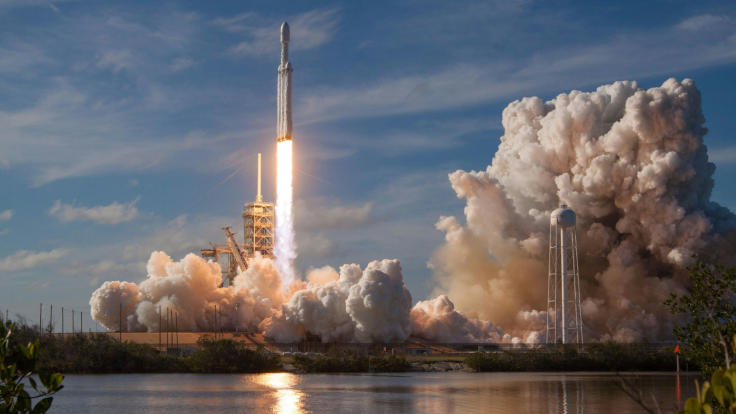
Japan has begun a five-year bid to pull off a world first: bringing rock and dust back from Mars' moon Phobos, in the hope that at least 10 grams of material could help rewrite what we know about the early solar system.
The Japan Aerospace Exploration Agency's (JAXA) Martian Moons eXploration spacecraft, or MMX, lifted off from Tanegashima Space Center in southwestern Japan before dawn on Tuesday, 20 October, aboard an H3 rocket.
The spacecraft left Earth at 4.41am local time. JAXA later confirmed that MMX had separated from the launcher and was operating normally, according to the agency's live broadcast.
The mission's target is strikingly modest for such a long journey: 10 grams, roughly the weight of two £1 coins. Yet if MMX succeeds, those grains could help answer one of planetary science's more stubborn questions, namely where Mars' two small moons actually came from.
Inside the MMX Mission
MMX is expected to reach Mars in August 2027. It will then study the planet and its moons before attempting to collect material from Phobos, with a return to Earth targeted for 2031.
Phobos is the larger of Mars' two moons. It is an irregular lump of rock measuring about 27km by 22km by 18km and orbits roughly 6,000km above the Martian surface, circling the planet three times each day.
JAXA hopes the samples will shed light on the origin of Phobos and Deimos, Mars' second moon, and deepen understanding of the solar system's early stages. The agency has described the mission as a potential first: no spacecraft has previously returned samples from a Martian moon.
The spacecraft will not simply grab a handful of dust and leave. It is designed to make two touchdowns on Phobos, collect and stow material in a return capsule, then make the long trip home.
A Redemption Flight for H3
For JAXA, the launch also carried a quieter significance. This was the first interplanetary mission for Japan's H3 rocket, the country's flagship launcher.
The H3's debut in 2023 ended when its second-stage engine failed to ignite. Since then, the rocket has completed a series of mostly successful launches, making Tuesday's departure an important test of whether it can now be trusted with the most demanding missions.
The rocket placed MMX on course for Mars about 71 minutes after liftoff, and mission control's response suggested the relief was real.
There is still an enormous amount that can go wrong. A launch is only the opening act, and MMX must survive a roughly 10-month cruise, Mars orbit operations, landings on a low-gravity moon and a return journey before any sample reaches a laboratory.
Why Phobos Could Unlock Mars' Past
Phobos may look like little more than a battered potato in space, but its composition could be revealing. Scientists want to know whether it is a captured asteroid or material formed close to Mars, perhaps after a giant impact.
The answer matters beyond Mars. If Phobos contains ancient material from the early solar system, it could offer a rare, relatively untouched record of conditions billions of years ago.
MMX is led by JAXA and involves NASA, France's CNES, Germany's DLR and the European Space Agency. A French-German rover named IDEFIX is also part of the mission and is intended to travel across Phobos, carrying out surface observations to help ensure a safe landing.
That international backing reflects the scale of the challenge. Landing on a moon just 22km across, where gravity is feeble and the surface is poorly understood, is not routine, even for agencies that have landed on comets and asteroids.
What Happens Next
JAXA will now track MMX as it travels towards Mars. The spacecraft is due to arrive in the planet's neighbourhood next summer, after which engineers will begin the detailed work of mapping Phobos and selecting landing sites.
The mission's timetable leaves little room for complacency. Samples are not expected back until 2031, meaning success or failure remains years away.
The launch gives Japan a realistic chance at a scientific first. Ten grams may not sound like much. In space exploration, though, it could be enough to rewrite a chapter of the solar system's history.
© Copyright IBTimes 2026. All rights reserved.