Naomi Osaka Conquers Her Grass-Court Fears with Stunning Win Over Aryna Sabalenka
Osaka's grass-court transformation under coach Tomasz Wiktorowski leads to a stunning victory over Sabalenka.

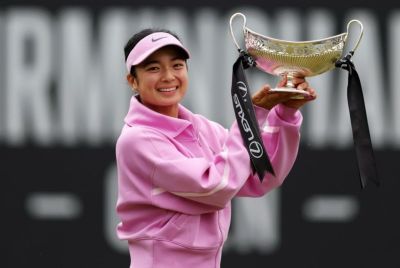
Naomi Osaka tore up the grass‑court script at Wimbledon on Sunday, defeating world No.1 Aryna Sabalenka 6-2, 7-6(2) on Centre Court to reach her first quarter-final at the Championships and show that her comeback is firmly on track.
Osaka arrived at this Wimbledon still regarded as a hard‑court specialist, a four‑time Grand Slam champion whose best memories were made in Melbourne and New York rather than on the lawns of SW19. She had also lost all three of her meetings with Sabalenka earlier this season and for years has spoken openly about feeling uncomfortable on grass. That narrative, at least for now, has been challenged.
Seeded 14th this fortnight, Osaka came into Wimbledon off a runner‑up finish in Bad Homburg, a smaller warm‑up event that hinted at a shift in her relationship with the surface. Under coach Tomasz Wiktorowski, the former world No.1 has been reworking her game and, importantly, her confidence since returning from maternity leave in July 2023.
Osaka Turns The Sabalenka Script On Its Head
Osaka's win over Sabalenka was not a narrow upset. For years, Sabalenka has been the one dictating baseline exchanges, controlling opponents with heavy serves and forehands. On Sunday, Osaka matched and surpassed that power.
The Japanese player struck 21 winners, including a crouching inside‑out backhand that helped secure the first break for 2-1 in the opening set. Her tennis was assertive and she mixed in smooth forays to the net that once felt unlikely for a player who used to hug the baseline.
The first set lasted just 32 minutes, Osaka moving through it as Sabalenka produced errors and struggled to land enough first serves to keep the rallies on her terms. Osaka's own serve, now featuring more variation under Wiktorowski's guidance, helped her in the few tight moments she faced.
Sabalenka responded with intent. The Belarusian top seed roared after winners, hit powerful groundstrokes and used slice backhands to disrupt Osaka's rhythm. She fought hard enough to extend the second set into a tie‑break, a situation that has usually favoured her.
Before this match, Sabalenka had won 21 consecutive Grand Slam tie‑breaks, extending that run earlier in the week at SW19. Osaka stopped it at 21. She moved ahead 5-1 in the breaker, playing with a clarity that has often eluded her on grass, and closed the match out.
Afterwards, Sabalenka's assessment was direct. 'Obviously I'm not happy with the way I played, but she overpowered me. I felt like it was incredible level from her,' the world No.1 told reporters, making it clear this was about Osaka's level, not only her own performance.
The Coach Behind Osaka's Grass‑Court Shift
Asked what had changed for her on grass, Osaka did not hesitate. 'The big Polish man, shout out Tomasz!,' she said on court, pointing to Wiktorowski in her player box as he stood to acknowledge the crowd. 'Shout out to my team, they are the best ever. I have so much fun with them and I'm very grateful they're on this journey with me.'
Later, in the press room, Osaka was more reflective. She admitted her 'relationship with grass and Wimbledon hasn't been the best' when she was younger and said she was 'not really sure' why she feels so comfortable now. Then she returned to the work.
According to Osaka, the pair have done 'a lot of drills' that were less about the specific surface and more about 'pattern recognition and things like that, getting me comfortable with my own game'. Over the season, she said, Wiktorowski has been helping her feel more secure about her movement and tactical plans against different opponents.
Under Wiktorowski, who previously guided Iga Swiatek, Osaka reached the 2025 US Open semi‑finals, then produced deep runs at Roland Garros and now Wimbledon. For a player whose past seasons were often inconsistent, that kind of steady progress is notable.
Osaka's own description of the match showed how much this win meant to her. 'Going into this match, I lost to her three times in a row, so that really sucked. I wanted to turn it over and I'm really glad I got the opportunity to do it,' she said with a grin. She added that this was the first match she had ever won on Centre Court and that 'it's been a long time since I've had so much fun on the court'.
By the end, the 28‑year‑old left to a standing ovation on Centre Court and is now within three wins of her first Grand Slam trophy since the 2021 Australian Open.
© Copyright IBTimes 2025. All rights reserved.
- Recommended For You