

World's Richest Sovereign Fund Eyes Nuclear-Weapons Firms as Government Moves to Weaken Its Ethics Watchdog
A government-appointed committee also wants to remove the ethics watchdog's power to recommend company exclusions, prompting warnings from Amnesty International
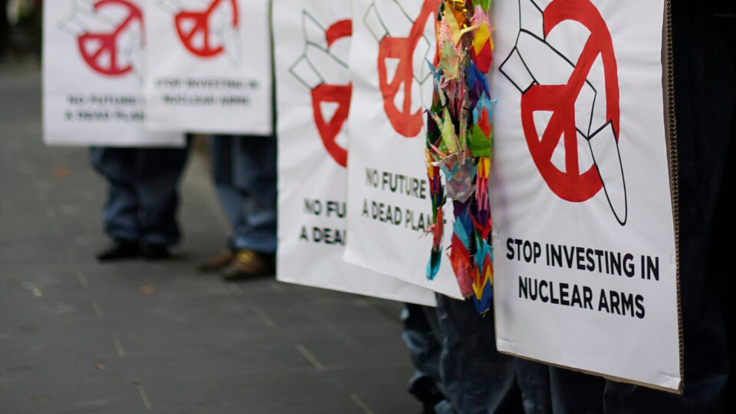
Norway's £1.7 trillion ($2.3 trillion) sovereign wealth fund, the largest in the world, could soon be permitted to invest in some American, British and French nuclear weapons makers, under proposals that would also curb the powers of its ethics watchdog.
A committee appointed by the Norwegian government and chaired by former central bank governor Svein Gjedrem delivered its recommendations to Finance Minister Jens Stoltenberg on Thursday 15 October 2026. Amnesty International said the changes would amount to the biggest setback for the fund's human rights safeguards in 20 years.
The proposals now go to public consultation and will not change the fund's rules unless the government adopts them.
Nuclear Arms Makers Back Within Reach?
The Government Pension Fund Global, built on Norway's oil and gas revenues, owns about 1.5 per cent of the world's listed shares across more than 7,000 companies, Euronews reported. It currently excludes 14 companies over nuclear weapons work, including Airbus, BAE Systems, Boeing, Lockheed Martin and Safran.
The committee recommends an exception for producers based in countries that are both recognised nuclear-weapon states under the Treaty on the Non-Proliferation of Nuclear Weapons and NATO allies of Norway. Eligibility would depend on those criteria, not on any automatic decision to buy.
'This means that several British, French and American arms manufacturers will be brought back into the fund,' Gjedrem said. Other exclusions, covering biological and chemical weapons, landmines, cluster munitions, coal, tobacco and cannabis, would remain.
The committee frames the proposed exemption as a national-security measure. 'The companies that would be reincluded produce weapons that Norway needs for its own defence,' it says, pointing to the country's reliance on NATO's nuclear umbrella, Al Jazeera reported.
Stoltenberg, a former NATO secretary general, highlighted 'the paradox' that 'the Norwegian fund cannot invest in companies that could be crucial for Norway's security', as Russia issues nuclear threats and China expands its arsenal.
Anti-nuclear campaigners were scathing. 'Nuclear weapons are weapons of mass destruction, there is nothing ethical about them,' said Melissa Parke, executive director of the International Campaign to Abolish Nuclear Weapons. 'Norway would make itself complicit, knowingly, when nuclear weapons are used again,' she said.
Norway's parliament rejected a similar proposal from the Progress Party, on producers of nuclear weapons components, by 90 votes to 12 on 4 June 2025.
Ethics Watchdog Risks Losing Its Bite
The second strand of the report concerns the fund's independent Council on Ethics, whose exclusion recommendations have made Norway one of the most closely watched investors in the world. Under the proposals, the council would still assess whether companies risk serious ethical violations, but would no longer recommend exclusion or observation.
The council's exclusion recommendations were put on hold pending the review, a temporary pause separate from the permanent change now proposed. Norges Bank Investment Management, the arm of Norway's central bank that runs the fund, would decide the response.
Some of the council's risk assessments could also be kept confidential where the fund's economic interests or the bank's management duties are at stake. 'First, the watchdog loses its teeth. Then the curtains are drawn,' said John Peder Egenæs, secretary general of Amnesty International Norway. 'The fund belongs to the Norwegian people, yet they risk losing access to information about any serious abuses that their money could be linked to,' he said.
Engagement with companies would replace exclusion as the main response to ethical risks. The bank would have to exclude a company only if engagement failed or had no realistic prospect of success, unless exclusion would limit the fund's ability to stay broadly diversified.
'An abuse does not become less serious because a company is large or an investment profitable,' Egenæs said. He warned the approach could make some holdings 'too big to exclude.'
The committee also proposes dropping a specific criterion on arms sales to states that use them to commit serious violations of international humanitarian law. It would keep a criterion on serious violations of individuals' rights in war and conflict, and expand one covering arms sales to states under sanctions or arms embargoes backed by Norway, Amnesty said.
Sales of generic technology products, such as cloud computing and artificial intelligence, should normally fall outside conduct-based exclusion, the report says.
Gaza Fallout and Diplomatic Pressure
The review was partly prompted by the fund's handling of investments linked to the war in Gaza, though not by that alone. In 2025, the fund divested from the US construction equipment maker Caterpillar, citing the company's alleged involvement in Israeli rights violations in Gaza and the occupied West Bank. Al Jazeera reported that Washington has since pressured Oslo over the move.
'Parts of the rationale for the appointment of the Committee was the Fund's management related to the war in Gaza,' the report says. It argues that judgments about 'another state's conduct' should be 'reserved for the ordinary diplomatic channels of the Norwegian authorities.'
Opposition politicians, particularly on the left, have attacked the report, with one Green Party official calling it 'utterly senseless.' Lawrence Loh of the National University of Singapore warned that weakening the fund's standards could 'open Pandora's box' for other investors.
Gareth Evans, the former Australian foreign minister, struck a different note, calling the report 'an encouraging initiative.'
Public consultation runs until 15 January 2027, and the government aims to present its assessment to parliament in a white paper on the fund in spring 2027.
© Copyright IBTimes 2026. All rights reserved.