Are the Peru Conehead Mummies Aliens? Paranormal Expert Claims Skulls Are Not Human Beings
Inconclusive DNA results reignite debate over the Paracas skulls' origins

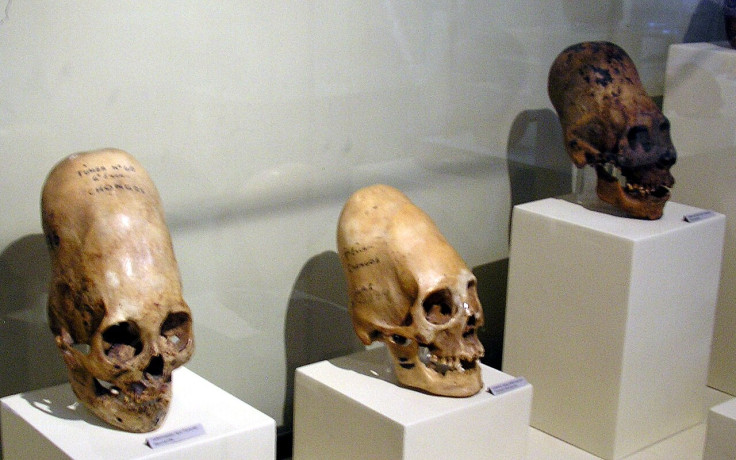
New DNA tests of the Paracas skulls have failed to disprove the Peru mummies' alien origins.
Ancient aliens proponents saw a recent DNA analysis of the Paracas skulls as proof of their extraterrestrial origins. Researchers at the Liberty University of Virginia conducted a fresh barrage of tests on Peru's conehead mummies to map their genetic code, and the results were inconclusive.
The Paracas skulls, a collection of 300 remains unearthed by archaeologists in the 1920s, have long since fascinated paranormal experts, many claiming the skulls belonged to mummified aliens or non-humanoid species. Scientists have since disputed those claims, attributing the skulls' elongated shapes to an ancient tribal practice.
Are the Peru Conehead Mummies Aliens?
'Some archaeologists and geneticists attributed the deformation to the cultural practice of cranial binding, which uses pressure to morph the skull, often a societal symbol of wealth or importance,' researcher Abigail McDowell said, per the Daily Star. 'Others believed the Conehead mummies were proof of extraterrestrial visitors, claiming the mummies were descendants from non-humanoid species or actual aliens themselves.'
David Childress is a familiar figure in the ongoing debate. Prominently featured in the History Channel's Ancient Aliens series, he claimed the Paracas skulls actually belonged to a tribe that was trying to mimic their cosmic visitors. He cited the same practice was observed in tribes scattered across the globe.
The Paracas Skulls and Ancient Aliens
'The puzzle of why diverse ancient people - even on remote Pacific Islands - would use head-binding to create elongated heads is mystifying. Where did they even get this idea?' Childress wrote in his book 'The Enigma of Cranial Deformation', co-authored by Brien Foerster.
Foerster's colleague, Lloyd Pye, went further by stating the Paracas skulls were 'not human beings.' Pye had also previously claimed a deformed Mexican skull with similar characteristics was actually a 'Starchild,' or a human-alien hybrid.
The Paracas skulls were elongated because the ancient humans bound their babies' heads. The practice persisted between 800 BC and 100 BC, according to historical consensus, but critics argue that theory was largely founded on visual checks.
The Liberty University of Virginia's researchers failed to map the Paracas mummies' genetic code, fueling ancient aliens theories. However, the tests were inconclusive because the samples were too small to offer definitive results. There's also the challenge of extracting better quality DNA from teeth and bone samples, most of which have significantly deteriorated over the years.
Peru Mummies Were Humans, According to Anthropologist
Claims of the Paracas skulls' alien origins were also debunked in 2022, following a wild social media post. The poster noted the elongated skulls and the eye sockets' shapes, which were '100 per cent alien.' Melissa S. Murphy, anthropology professor at the University of Wyoming, dismissed the theory.
'The eye sockets are normal and perfectly within the range of human variation and look like eye sockets of other human skulls from Peru,' she told USA Today. She also asserted the skulls' shape was the result of cranial deformation or head binding.
'Pre-Hispanic peoples on the south coast of Peru and elsewhere in Peru have engaged in this practice for thousands of years,' she explained. 'Deliberate head shaping is a form of cultural modification of the body that marks different things, like one's identity, a rite of passage, (or) an occupation.'
© Copyright IBTimes 2025. All rights reserved.
- Recommended For You