Why Queensland Is Australia's Fastest-Growing State Economy, and What's Driving the Interstate Exodus
Queensland's economic boom: a diverse industry expansion
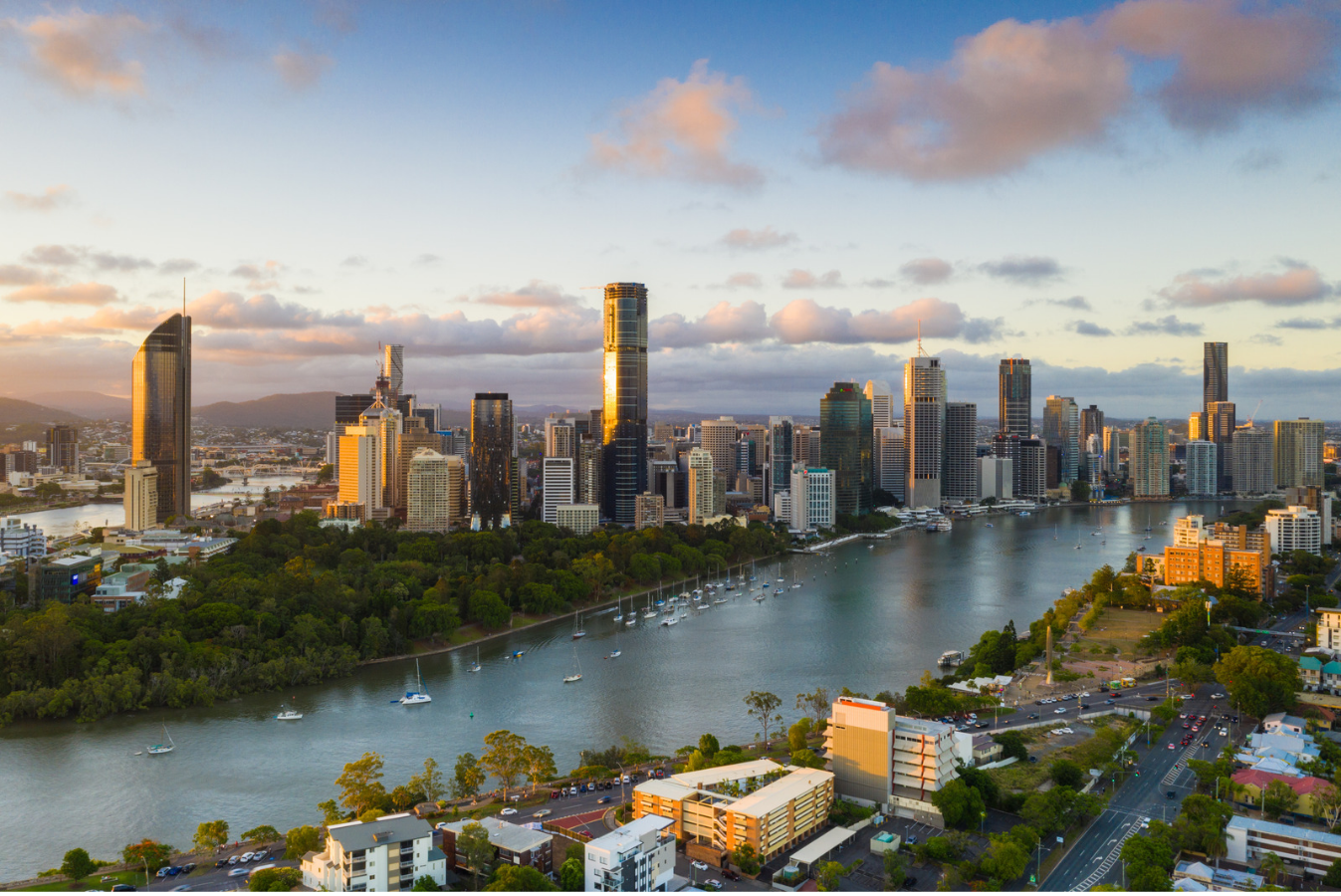
While national economic growth in Australia crawled to 1.4 per cent in the year to June 2025, one state economy pulled clearly ahead of the pack.
Queensland grew 2.2 per cent over the same period, the fastest expansion of any Australian state, trailing only the Australian Capital Territory's 3.5 per cent, a territory rather than a state and a very different kind of economy built around federal public administration rather than resources, tourism and construction.
The more telling number sits underneath the headline growth figure. Queensland was one of only three jurisdictions in the country, alongside the ACT and Tasmania, where economic growth per capita actually outpaced population growth. That distinction matters more than it first appears.
A state can grow simply by adding more people to an unchanged economy. Queensland's growth is outrunning its own population increase, which is a signal of genuine economic expansion rather than population dilution disguised as growth.
What Is Actually Driving It
Queensland's state budget forecasts growth strengthening further, to around 2.5 per cent in 2025-26, and the industries behind that number are broad rather than concentrated in a single sector.
Tourism remains one of the largest single contributors, generating 15.7 billion Australian dollars in gross value added in the 2023-24 financial year and accounting for close to a quarter of the nation's entire tourism output, a disproportionate share for one state. The sector directly employs 156,000 people in Queensland.
Construction has become the state's second-largest employing sector, with 288,000 people working in it as of 2025, a figure that predates the bulk of Olympic-related building still to come.
Financial and professional services, often overlooked in a state associated more with resources and tourism, contributed 63.2 billion dollars in economic output in 2024-25 and employed over 313,000 people. This is evidence that Queensland's growth is not purely a mining and tourism story but includes a genuine services economy expansion running alongside it.
Resources and LNG remain structurally important, with continued strength in mining investment and exports contributing to the broader growth figures even as the national picture showed weakness in mining and manufacturing over the same period. Queensland's resources sector has effectively been growing against the national trend rather than with it.
The Population Side of the Story
Economic growth and population growth in Queensland are feeding each other, and the clearest evidence of that sits in interstate migration data.
The most recent full year of Australian Bureau of Statistics figures show Queensland gained 21,595 net interstate migrants, the strongest net inflow of any state in the country. New South Wales, over the same period, lost 24,328 residents to other states, the largest net outflow in the nation and almost a mirror image of Queensland's gain.
This is not a new pattern, but it has hardened into a structural one rather than a temporary post-pandemic blip. Every state and territory except Queensland and Western Australia recorded net interstate migration losses in the most recent data, meaning two economies are effectively absorbing the outward movement from the rest of the country. Queensland's share of that movement is the larger of the two.
The reasons behind the shift are the ones that show up in cost-of-living surveys comparing Sydney and Melbourne against Brisbane: relative housing affordability, even accounting for Brisbane's own recent price growth, a lower overall cost of living, and a job market that has been expanding rather than contracting.
Remote and hybrid work arrangements, now a permanent fixture rather than a pandemic-era exception for a meaningful share of the workforce, have loosened the requirement to live within commuting distance of a Sydney or Melbourne office, potentially allowing a portion of that newly mobile workforce to choose Queensland specifically rather than simply the cheapest option available.
Brisbane Absorbs the Most, but the Growth Is Not Confined to One City
Brisbane captures the largest single share of interstate arrivals and the largest share of media attention, partly because it is also preparing to host the 2032 Olympic and Paralympic Games, backed by a combined infrastructure investment north of nineteen billion dollars across venues and transport.
But treating Queensland's growth story as a Brisbane story alone understates how distributed the underlying trend actually is.
The population data around Brisbane's immediate region shows the scale, with the Gold Coast adding roughly 68,000 residents between 2019 and 2024, Logan around 61,000 and Ipswich approximately 51,600 over the same window.
These are growth corridors that sit adjacent to Brisbane rather than inside its formal boundary, and they are absorbing much of the practical overflow from the capital's own housing constraints.
Further north, Far North Queensland tells a different but related story. Cairns and the surrounding region have long served as a base for fly-in fly-out mining and resources workers commuting to the Bowen Basin and nearby sites, a function that continues to anchor a meaningful share of the regional economy.
What has changed more recently is the composition of new arrivals beyond that established workforce: a rising share of people in the thirty-to-forty-nine age bracket, a cohort that brings school enrolments, mortgage demand and long-term consumer spending rather than the more transient footprint associated with fly-in fly-out rotations or retirement relocation alone.
Cairns is no longer simply a warm-climate retirement destination for people leaving the workforce. It is increasingly a destination for people bringing their working careers with them.
Where the Population Data Shows up Before the Official Statistics Do
Official migration and population statistics lag reality by design, built from tax and Medicare enrolment records that take months to process and publish. The more immediate signal, for anyone trying to track the trend in something closer to real time, sits in an unglamorous industry that rarely makes an economic analysis: the moving and relocation sector itself.
Brisbane removalists have reported a sustained increase in interstate bookings that tracks closely with the state-level migration data, typically visible in booking volumes and lead times well before the equivalent numbers appear in an ABS release.
The same pattern holds further north. Cairns removalists describe a customer base that has shifted materially over the past several years, from a market once dominated by retirees and fly-in fly-out workers relocating temporary belongings, toward a genuine mix that increasingly includes working families making a permanent move.
R2G Transport & Storage, which operates across both the Brisbane and Far North Queensland corridors, is well placed to observe that shift directly, since interstate relocation bookings function as a leading indicator of population movement rather than a lagging one. A household does not book an interstate move after they have already relocated.
The booking data reflects intent and commitment months before the person shows up in a census or tax record, which makes it one of the more immediate, if unofficial, gauges of exactly the migration pattern behind Queensland's growth numbers.
The Strain That Comes With Growth This Fast
None of this growth is without cost. Brisbane's rental vacancy rate has been sitting close to 0.8 per cent, a level that reflects genuine housing scarcity rather than a market simply running warm, and rents have risen accordingly.
Construction capacity, already stretched by ordinary population growth, now has to absorb Olympic venue and transport construction on top of existing housing demand, a combination that risks bidding up construction costs and extending build timelines across the residential sector at the same time infrastructure crews are competing for the same skilled labour.
There is also a reasonable question about durability. Queensland's current growth rate is unusually strong relative to its own history and relative to the rest of the country, and growth running meaningfully ahead of population increase in per capita terms is a positive signal, but it is not automatically permanent.
Much of the current construction and infrastructure spending is tied to a fixed event six years out, and what happens to the state's growth trajectory once Olympic-related building activity tapers is a genuinely open question rather than one the current data can answer.
The Bigger Picture
Queensland's position as the country's strongest-performing state economy is not the product of a single factor.
It reflects a broad industry base spanning tourism, construction, resources and a genuinely expanding services sector, layered on top of the largest net interstate population gain of any state in the country, with a $6 billion-plus Olympic infrastructure programme still largely ahead of it rather than behind it.
Two other Australian jurisdictions are losing population to interstate migration for every one that is gaining it in Queensland's favour, and that imbalance shows no sign of reversing in the near term.
For a national economy growing at 1.4 per cent, a state economy growing at 2.2 per cent and forecast to accelerate further is not a marginal difference. It is the clearest evidence in the country's own data of where economic activity, and the people who generate it, are actually moving.
What happens next depends less on any single Olympic venue and more on whether housing supply and skilled labour can keep pace with a population inflow already running at the fastest rate of any state in the country.
Every one of the growth drivers behind Queensland's current numbers, tourism, construction, resources and services, ultimately competes for the same finite pool of workers and the same constrained housing stock.
Queensland's growth story over the next several years will be decided less by whether people keep choosing to move there, since the interstate migration data already answers that question clearly, and more by whether the state can build fast enough to keep absorbing them.
© Copyright IBTimes 2026. All rights reserved.
- Recommended For You