

Scientists Find Possible Link Between Shroud of Turin and Ancient Cloth Said to Have Covered Jesus' Head
Experiments reproduced bloodstain patterns on the Sudarium, but researchers have not established that either relic belonged to Jesus Christ
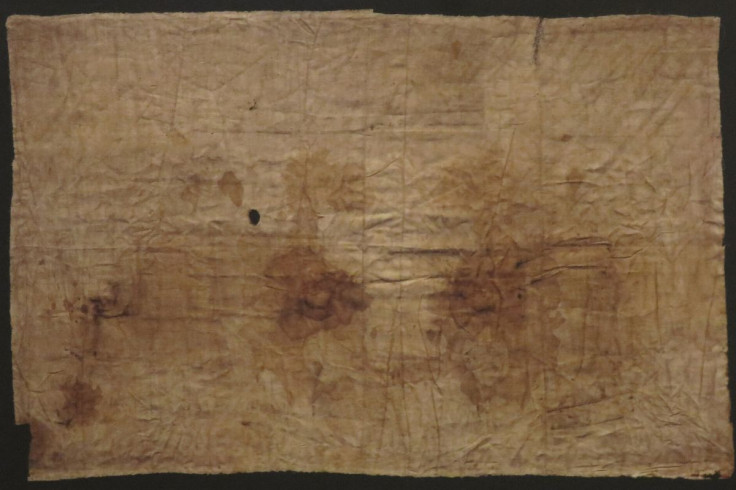
Spanish scientists have uncovered fresh clues surrounding two sacred relics traditionally associated with the burial of Jesus Christ, raising the possibility that the Shroud of Turin and the Sudarium of Oviedo once covered the same individual.
The research, published in the September–October 2026 edition of the Journal of Cultural Heritage, examined bloodstain patterns on the Sudarium, while a separate preliminary investigation identified possible similarities with injuries depicted on the Shroud of Turin.
Although the findings have renewed interest in one of Christianity's most enduring mysteries, researchers have not established that either cloth belonged to Jesus.
Scientists Recreate Bloodstains on Ancient Burial Cloth
Led by Pedro Peinado Rocamora of the University of Oviedo, the research team investigated whether distinctive markings on the Sudarium could have resulted from bandages securing the material around a deceased person's head.
The relic, preserved in Oviedo, Spain, measures approximately 33 by 21 inches (84 by 53 centimetres). Christian tradition associates it with the separate head covering described in the Gospel of John's account of Jesus' empty tomb.
Researchers conducted controlled experiments involving a model head, linen fabric, and artificial blood warmed to approximate body temperature.
By altering the model's position, they reproduced patterns resembling markings on the original textile. Their findings indicated that pressure from external wrappings could influence where fluids accumulated.
A separate nine-hour examination of the relic on 2 July reportedly involved X-rays and three-dimensional scanning, providing additional observations consistent with the bandaging hypothesis.
However, the experiments had limitations, including differences between the original and replacement fabrics, alongside the absence of hair on the model.
Did Both Cloths Cover the Same Person?
Peinado is now examining whether the Sudarium's bloodstains correspond with apparent injuries depicted on the Shroud of Turin, which bears the front and back impressions of a man's body.
His preliminary, unpublished analysis reportedly indicates possible similarities around the forehead and rear of the head.
Such correspondences could strengthen the hypothesis that the two textiles were used on the same individual during different stages of burial preparation.
Under the proposed reconstruction, the deceased was initially held upright before being inclined and eventually placed face-up beneath the larger shroud.
Changes in body position could potentially account for differences between the markings found on the two relics.
Nevertheless, the comparative findings remain unpublished, meaning other researchers have yet to independently evaluate the evidence supporting that proposed connection.
Carbon Dating Challenges the Jesus Christ Theory
Despite the emerging forensic observations, significant questions remain surrounding the age and authenticity of both religious artefacts.
Radiocarbon testing conducted in 1988 dated the Shroud of Turin to between 1260 and 1390, placing its estimated origin more than a millennium after the crucifixion of Jesus Christ.
Dating evidence associated with the Sudarium has also suggested an origin centuries after his death.
These chronological discrepancies remain important obstacles to establishing the relics' biblical authenticity, regardless of whether their markings prove compatible.
Even if further research conclusively establishes that both textiles covered the same person, identifying that individual as Jesus would require additional historical and archaeological evidence.
For now, the findings offer a possible explanation for how the Sudarium's markings developed, alongside a new avenue for investigating its relationship with the Shroud of Turin. The question of whose body the textiles covered remains unresolved.
© Copyright IBTimes 2026. All rights reserved.