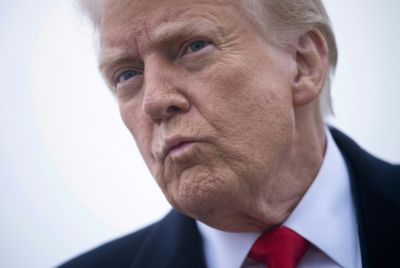
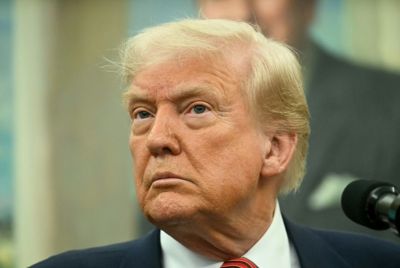
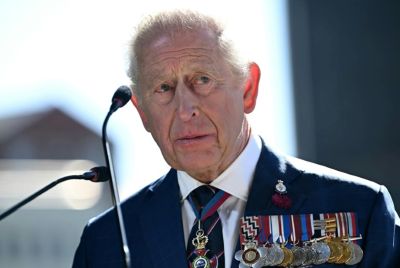
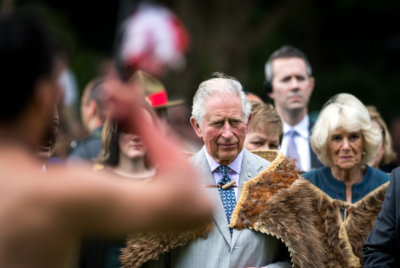
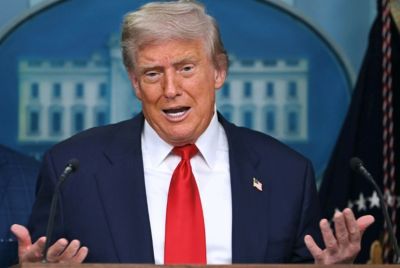
Donald Trump Plots to Embarrass King Charles as 'Payback' for UK Foreign Policy Stance: Report
Donald Trump reportedly plans to challenge King Charles on the Falkland Islands, turning a diplomatic visit into a test of British sovereignty.

Donald Trump is preparing to confront King Charles over British sovereignty of the Falkland Islands when the monarch visits Washington on Monday, according to a leaked Pentagon memo that suggests the US president wants to embarrass the king as payback for the UK's recent foreign policy stance.
The memo, reported by The Daily Beast, sets out how Donald Trump allegedly intends to use the visit to challenge whether King Charles should control the Falkland Islands, a British Overseas Territory in the South Atlantic claimed by Argentina. The reported plan follows Prime Minister Keir Starmer's refusal to support a US‑led blockade of the Strait of Hormuz, a key shipping lane near Iran, a move that appears to have irritated the White House and prompted a search for leverage.
LBC confirms a terrifying leaked Pentagon document. The Trump administration is actively planning to punish NATO members by renouncing the UK's sovereign right to the Falkland Islands. Donald Trump is deliberately betraying Britain to reward his political allies in Argentina. pic.twitter.com/0ppHEJZ54W
— Furkan Gözükara (@FurkanGozukara) April 24, 2026
The Falklands remain an emotionally loaded subject in the UK. Britain fought a brief but costly war with Argentina in 1982 after Buenos Aires invaded the islands. More than 900 people were killed before British forces re‑took control.
The territory has since been held up by successive UK governments as non‑negotiable. It also touches the royal family personally. Prince Andrew, King Charles' younger brother, served as a Royal Navy helicopter pilot during the conflict, a detail the memo reportedly flags as evidence that the topic could cause discomfort.
King flies into a US storm over Falklands: Days before Charles' visit, leaked memo says Trump could axe support for UK sovereignty over the islands https://t.co/heIgPzPCAi
— Daily Mail (@DailyMail) April 24, 2026
Trump, King Charles and Falklands Flashpoint
The leaked document describes Trump's planned intervention over King Charles and the Falkland Islands as a deliberate attempt to 'question' UK sovereignty rather than a passing remark, according to The Daily Beast. It portrays the issue less as a matter of principle and more as political retaliation for Starmer's stance over Iran and the Strait of Hormuz.
The memo also outlines a broader, and arguably more combustible, strategy. It says Washington could push for Spain to be expelled from NATO because of Madrid's reluctance to become more deeply involved in the war in Iran. The phrasing reported by The Daily Beast makes clear this is not a fully formed policy but a possible pressure tactic being discussed inside the administration.
Fury at 'schoolyard bully' Trump threatening to help Argentina's claim to Falklands - as MPs say King's State Visit should be called off https://t.co/ELit2PEoYw
— Daily Mail US (@Daily_MailUS) April 24, 2026
Nothing in the leak suggests that legal steps to remove Spain from the alliance are imminent, and such a move would face significant resistance from other NATO members. Still, the very idea being floated on paper reveals how aggressively Trump's team is willing to wield alliance politics to reward support and punish hesitation.
On the British side, the timing could hardly be more awkward. King Charles' trip to Washington was designed as a reset after a period of transatlantic friction. Instead, it now risks turning into a stage for a sovereignty dispute that London thought had been settled for a generation.
UK Political Backlash to Trump's 'Payback' Plan
The news landed quickly in Westminster. The Liberal Democrats, traditionally the most pro‑European of the UK's major parties, reacted with open alarm at the prospect of Donald Trump using King Charles as a prop in a Falklands confrontation.
Sir Ed Davey, the party's leader, called for the visit to be scrapped altogether. 'Any move by the president to question our sovereignty in the Falklands should be met by robust denouncement,' he told The Daily Beast. He went further, describing Trump as an 'unreliable, damaging President' who 'cannot keep insulting our country.'
🚨⚡️ Diplomatic tension between London and Washington:
— RussiaNews 🇷🇺 (@mog_russEN) April 25, 2026
A leaked memo suggests the Trump administration is considering revising its long-standing support for British sovereignty over the Falkland Islands, amid growing political disputes with Starmer’s government. pic.twitter.com/F6EMyAX7Ch
For opposition parties, standing up for the Falklands is risk‑free territory. For the government, it is more awkward. Starmer will not want to be seen as cancelling a royal visit lightly, yet he will also know that any public questioning of the Falklands' status by a US president would trigger fury across the political spectrum.
Downing Street has not, in the material reported so far, offered a detailed response. Nor has Buckingham Palace. Without official confirmation of the memo's contents from Washington, both appear to be holding the line in public while allies assess how serious Trump is about following through.
The Falklands government has rebuked Donald Trump and told him the islands are British after the Pentagon drew up proposals to support Argentine claims over sovereignty
— The Telegraph (@Telegraph) April 24, 2026
Read how Islanders, veterans and Starmer rebuke US after Pentagon suggests supporting Argentina’s claim to… pic.twitter.com/zx5yhzZhqs
If Trump does raise the Falklands in front of cameras, the moment will resonate far beyond the diplomatic niceties of a state visit. For many in Britain, US support for UK sovereignty over the islands has long been taken for granted, almost an article of faith in the so‑called 'special relationship.' A very public wobble on that point, and one apparently motivated by irritation over Iranian policy, would mark a notable departure.
What happens instead may be quieter and more typical of these situations, frantic behind‑the‑scenes efforts to steer the president away from the most provocative talking points, careful drafting of communiqués, and a royal schedule re‑engineered to minimise the risk of unscripted confrontation. If the memo is accurate, though, Washington officials may find that containing their own commander‑in‑chief is the hardest part of the visit.
© Copyright IBTimes 2025. All rights reserved.
- Recommended For You