

Japan and US Deploy Missile Systems Near Taiwan During Drills Involving 45,000 Japanese and 11,000 US Troops
Missile deployments on Yonaguni bring advanced weapons near Taiwan as allies train to defend Japan's remote islands
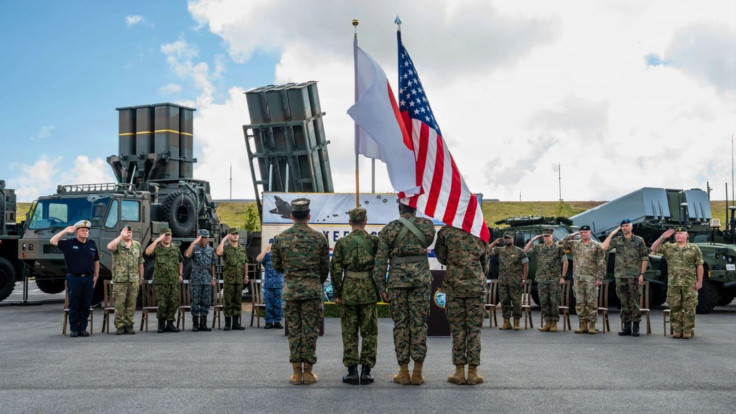
Japan and the US deployed missile systems to Japanese islands near Taiwan as Keen Sword 27 began on Monday, 19 October, bringing together around 45,000 Japanese troops and 11,000 American personnel.
Japan has reinforced its southwestern region with longer-range missiles and interceptors in recent years. Tokyo regards China's expanding military activity around the country as a threat and has raised particular concern over increasing activity near remote Japanese islands in the Pacific Ocean.
The biennial exercise, Keen Sword 27, runs until 29 October and focuses on defending Japan's southwestern islands and waters around its northern coasts.
Japan and US Position Missiles Near Taiwan
Yonaguni, Japan's westernmost island, has become a focal point of Keen Sword 27 because of its position just 110 kilometres (68 miles) east of Taiwan. Japanese and American forces have brought several missile systems to the island as part of the exercise.
The Japanese deployment includes the Type-25 land-to-ship missile, which has a reported range of approximately 1,000 kilometres (620 miles). That range places parts of mainland China within reach, although the weapon will not be test-fired during the drills.
American forces have positioned the Navy Marine Expeditionary Ship Interdiction System (NMESIS) and the Marine Air Defense Integrated System (MADIS) on Yonaguni. Meanwhile, a HIMARS rocket launcher has been deployed to Ishigaki, another island in Japan's southwestern chain.
Island Defence Shapes Japan and US Training
The exercises extend beyond missile deployment, covering amphibious landings, air and missile defence and mine sweeping. Intelligence gathering, logistics, resupply and casualty evacuation are also planned across several remote islands, including Tanegashima.
Seven other nations from the Indo-Pacific region and Europe are participating in parts of the exercise. Japan's Joint Staff identified France, Germany, the Netherlands, New Zealand and the Philippines as five first-time participants.
General Hiroaki Uchikura, chief of staff of the Joint Staff, denied that the exercises target any particular country.
At the opening ceremony on Ishigaki, Maritime Self-Defense Force Admiral Tateki Tawara described the aim as protecting both territory and people's peaceful lives, according to the Joint Staff.
'In order to do so, it is essential to be fully prepared and cooperate with our allies and partners to prevent the crisis.'
The drills take place amid tensions with China, North Korea and Russia. Relations with Beijing deteriorated after Prime Minister Sanae Takaichi stated in November 2025 that Chinese military action against Taiwan could justify Japanese involvement. Her remarks angered China, with tensions extending beyond military matters to affect economic ties.
Okinawa Concerns Accompany Japan and US Cooperation
Japan's expanding military cooperation with Washington comes alongside longstanding tensions over the American military presence, particularly on Okinawa.
The arrest of a US Marine in connection with the murder and robbery of a Japanese woman weeks before Keen Sword 27 has renewed scrutiny of American personnel stationed on the island. Residents have previously raised concerns about crimes involving service members, aircraft noise and environmental damage linked to military installations.
Concerns over personnel conduct have also reached Yokosuka. When the aircraft carrier USS Theodore Roosevelt briefly entered the US Navy base there last week before joining the exercise, local mayor Katsuaki Kamiji requested that Japan's Foreign Ministry convey to the US military the importance of crew members complying with Japanese rules.
© Copyright IBTimes 2026. All rights reserved.